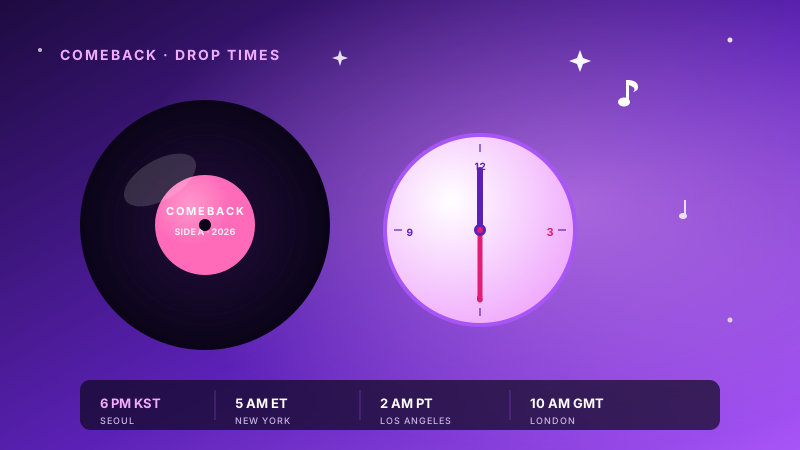
K-pop comeback drop times in EST/PST + the teaser timeline
6 PM KST = 5 AM ET = 2 AM PT. Why most US fans miss the first 90 minutes of streams that decide chart performance.
A K-pop "comeback" is a new album or single release. The Korean industry uses the word loosely — sometimes for any new release, sometimes only for full-album returns after a hiatus. For US fans, the operationally useful definition is: whenever the music video drops on YouTube and the streaming versions go live on Spotify and Apple Music.
The standard times
If you only memorize one thing, it's this:
6 PM KST = 5 AM ET = 2 AM PT (during US daylight saving)
Midnight KST = 11 AM ET = 8 AM PT (during US daylight saving)
6 AM KST = 5 PM ET = 2 PM PT (during US daylight saving)
Most major group title tracks drop at 6 PM KST. The whole album is usually live by midnight KST (which is 11 AM ET — easier for US fans). Pre-release tracks sometimes drop at 6 AM KST as a quiet teaser, but those are usually instrumental versions or solo extras.
During US standard time (November-March), shift everything an hour later in ET/PT.
Why these specific times
Korean music shows tape on Friday afternoons and broadcast Saturday morning. The 6 PM KST drop on Friday gives the song roughly 18 hours to chart on Korean streaming services (Melon, Genie, Bugs) before the Saturday show staff finalize ranking data. Midnight album drops are mostly for global streaming services that don't care about Korean charts.
For fans in the US, 5 AM ET is genuinely brutal. The alternative is to wake up and stream the album at midnight KST = 11 AM ET, but you've already missed the first 5 hours of the chart push.
What "supporting the comeback" looks like
If you're a fan who wants to actually contribute to chart performance:
-
Stream the music video on YouTube front-to-back, with sound, on the official upload. YouTube counts views toward Billboard Hot 100's streaming component. Auto-play loops in the background do not count — YouTube filters them out.
-
Stream the song on Spotify from a US account. Counts toward Billboard Hot 100, Billboard 200, and Spotify's Top Songs USA chart.
-
Buy a digital download on iTunes (US store) on release day. Counts toward sales charts.
-
Buy a physical album if you can swing it. Goes on sale roughly 2 weeks before the release date in the US (via Ktown4u, Apple Music store, or Weverse Shop). The pre-orders fed into release-week sales chart on Billboard 200.
If you do all four, you've contributed to roughly 8 different chart calculations from one comeback. If you only have time for one, YouTube full-watch on the official MV has the highest leverage for a US fan.
The teaser timeline
Before the comeback itself, the typical Korean group runs a 4-6 week teaser cycle:
| When | What |
|---|---|
| D-30 | "Coming soon" announcement on Twitter and Weverse |
| D-21 | Concept photos (member-by-member) released over a week |
| D-14 | Pre-order opens for physical album |
| D-10 | Tracklist reveal |
| D-7 | Highlight medley (audio teaser of all tracks) |
| D-3 | Music video teaser (15-30 second clip) |
| D-1 | Album cover reveal |
| D-0 (6 PM KST) | Title track + MV drop |
| D+0 (midnight KST) | Full album live |
| D+1 to D+5 | Music show promotions |
The teaser cycle is itself a marketing event. Concept photos generate Twitter trends weeks before the song exists. If you're trying to track multiple groups, the concept-photo phase is when you decide whether to commit time to a comeback.
Comebacks vs. tours
These are two separate cycles, but they sometimes intersect. A tour announcement often follows a comeback by 1-3 months, and the tour's opening night usually performs the comeback's title track. If a group's comeback is exceptional, the agency front-loads tour announcements to capitalize. If the comeback underperforms, the tour gets pushed back or the format scaled down.
A useful heuristic: groups that have not released new music in 6+ months are statistically about to enter a comeback cycle. If you've been waiting on a tour from a "quiet" group, the next comeback announcement is the strongest signal you'll get before the tour.
Last verified: May 2026. Drop times are stable across years; teaser cadence varies slightly by agency. JYP groups sometimes compress to 2-3 weeks; HYBE groups stretch to 6+.
See also: How to track comebacks before they're announced · The presale system explained